Start smaller
Reduce the habit until starting feels almost too easy. Small actions lower resistance and make repetition more likely.
The Habit Edit
Build a system that sticks.
A practical 4-week habit-building system designed to help you start smaller, create better cues and turn repeated actions into routines that survive real life.
Why Habits Stick
The goal isn't to feel inspired every day.
The goal is to make the action clear enough, small enough and familiar enough that you can keep doing it even when life is busy.
Reduce the habit until starting feels almost too easy. Small actions lower resistance and make repetition more likely.
Attach the new behaviour to something that already happens so the habit has a reliable trigger.
A habit only becomes useful when it survives ordinary days — not just highly motivated ones.
Identity First
Don't only ask:
“What do I want to achieve?”
Ask who you want to become — then choose actions that reinforce that identity through repetition.
Your Habit Toolbox
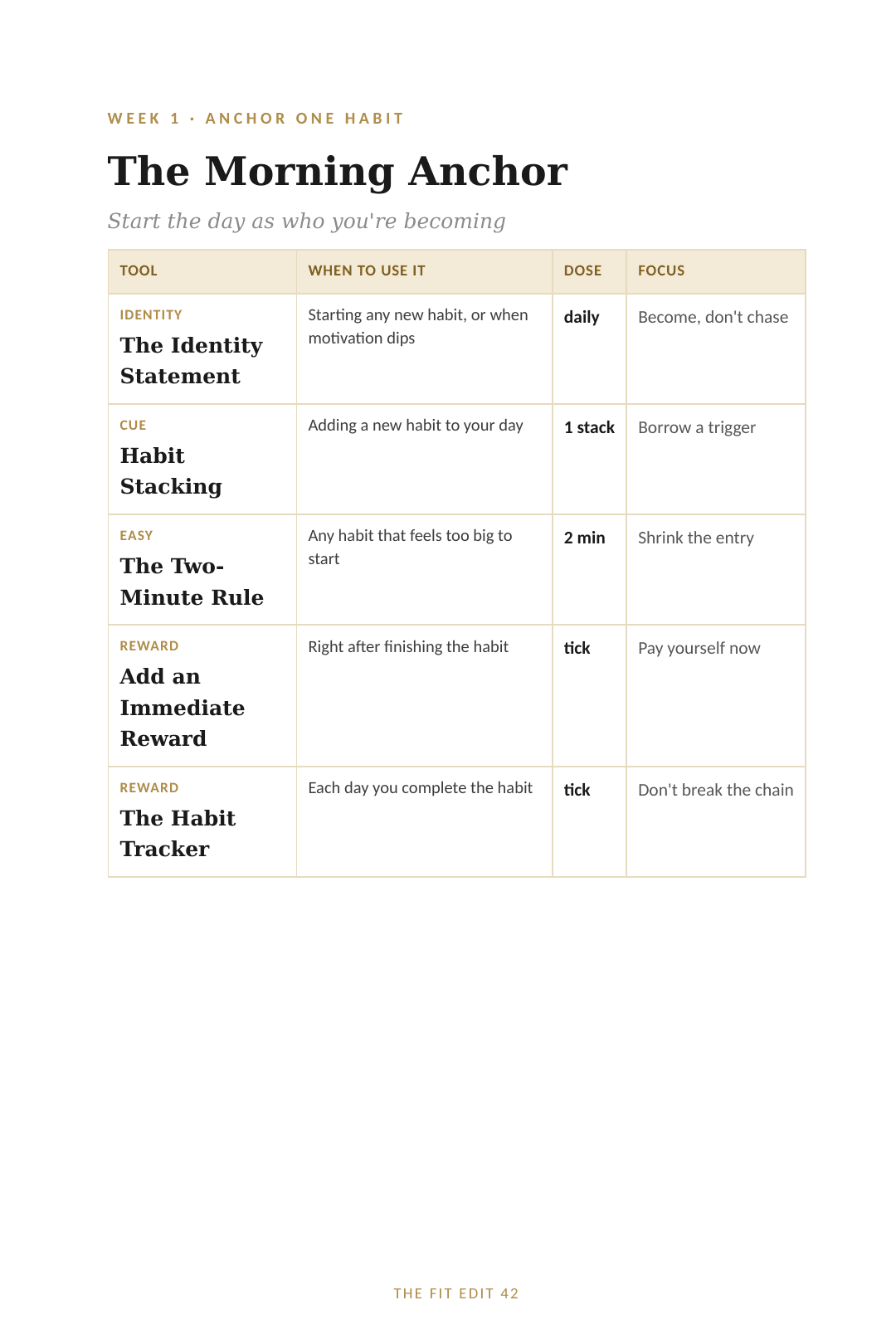
The same core tools stay with you across all four weeks.
What changes is how deeply you use them — first to begin, then to shape the environment, grow the habit and finally make it resilient.
Identity
Use it
When motivation dips
Focus
Become, don’t chase
Reframe the habit around the person you’re becoming. Instead of chasing a finish line, let each action become a vote for your identity.
Cue
Use it
When adding a new habit
Focus
Borrow a trigger
Attach the new behaviour to something you already do so the old routine becomes the cue for the new one.
Easy
Use it
When starting feels too big
Focus
Shrink the entry
Reduce the first version of the habit until it takes around two minutes. Make starting easier than avoiding it.
Reward
Use it
Right after the habit
Focus
Pay yourself now
Give the brain a small positive signal immediately after the behaviour instead of waiting weeks for the result.
Reward
Use it
Every completed day
Focus
Don’t break the chain
Make slow progress visible. Each mark becomes evidence that the behaviour is happening — and worth repeating.
The habit loop
Identity
becomes action.
The aim is not to force more discipline. It is to make the right behaviour easier to notice, easier to begin and satisfying enough to repeat.
And this is only the core five.
The full Tool Library contains twenty tools across identity, cues, ease, satisfaction and bulletproofing.
The 4-Week Journey
The program doesn't ask you to change everything at once.
Each week adds one new layer — first establishing the behaviour, then shaping the environment, expanding the habit and finally making it resilient enough to continue.
Week 01
Start
Choose one behaviour worth building and make the first version small enough to repeat consistently.
Focus
One habit · One clear cue
Week 02
Shape
Reduce friction for the behaviour you want and make the right action easier to notice and begin.
Focus
Cues · Friction · Environment
Week 03
Build
Once the habit feels stable, gradually expand the action without losing the consistency that made it work.
Focus
Progress · Capacity · Repetition
Week 04
Keep
Prepare for busy days, missed days and changing routines so the habit can survive real life.
Focus
Recovery · Resilience · Long term
The progression
Build the behaviour.
Then build the conditions that keep it alive.
A habit becomes useful when it works beyond the perfect week — when the schedule changes, motivation drops or life gets messy.
01
Start
Anchor One Habit
02
Shape
Design the Environment
03
Build
Grow the Dose
04
Keep
Bulletproof It
The Daily Practice
Habits are built in ordinary moments.
The program gives each day a simple rhythm so you can practice the behaviour, notice what gets in the way and keep the feedback loop going.
Morning
01
Start the day by reconnecting with the identity, cue and tiny version of the behaviour you are building.
During the day
02
Use the tools in real life — especially on busy or low-motivation days when the habit needs to stay easy.
Evening
03
Notice what worked, what created friction and what needs adjusting before the next repetition.
Daily
04
Track completion so progress becomes visible and each repetition adds another piece of evidence.
The feedback loop
Do it. Notice it. Adjust it. Repeat it.
You are not trying to prove that you can be perfect. You are learning how to make the habit easier to repeat tomorrow.
Make progress visible
M
T
W
T
F
S
S
Tracking is not about creating another obligation. It is a visual reminder that small actions are accumulating even when the final result is still far away.
Inside The Habit Edit
Less theory for theory's sake.
More tools you can actually use.
Learn why habits work, choose the right tool for the moment and apply it inside a guided four-week build.
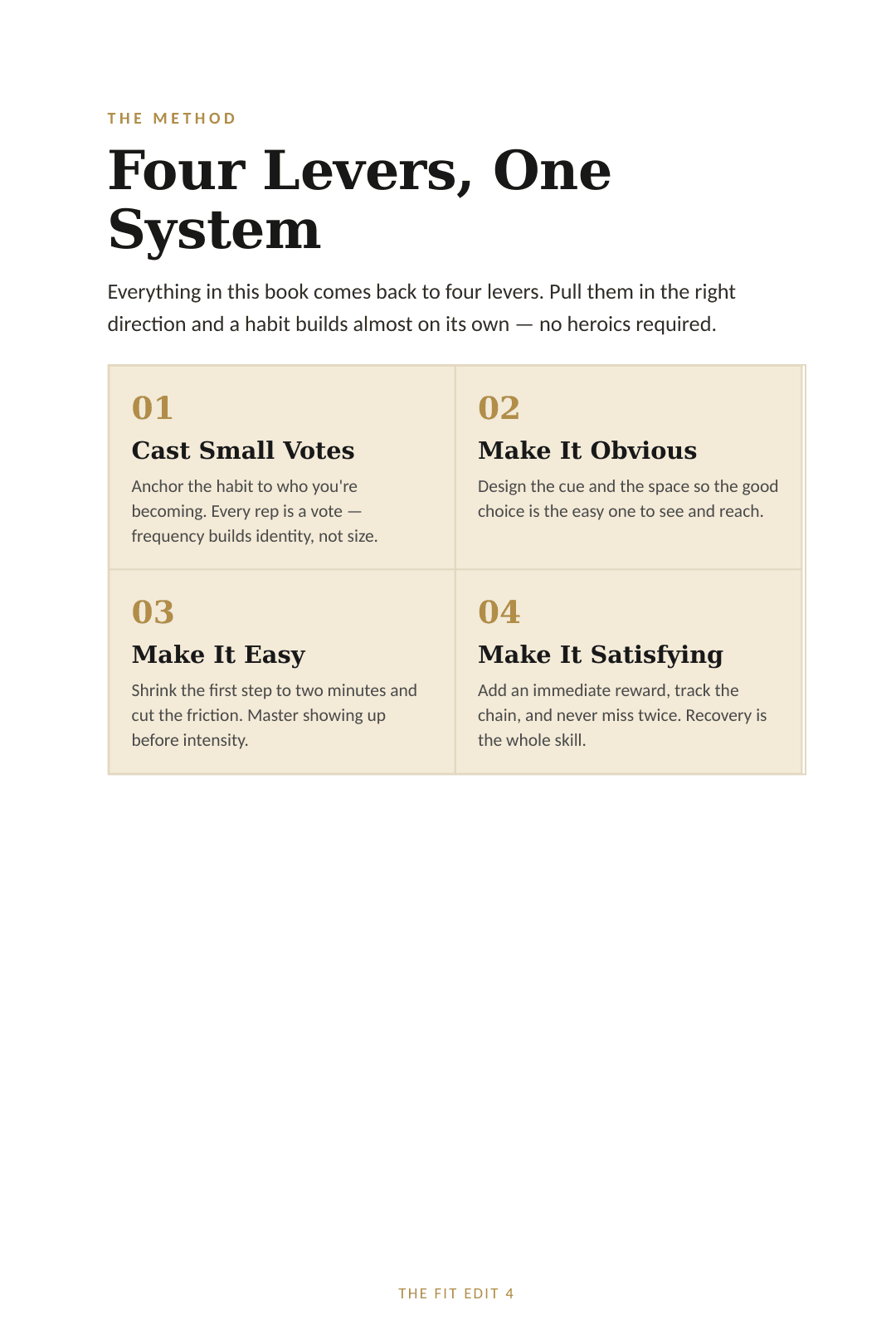
The Method
Cast small votes, make the cue obvious, make the action easy and make the result satisfying.
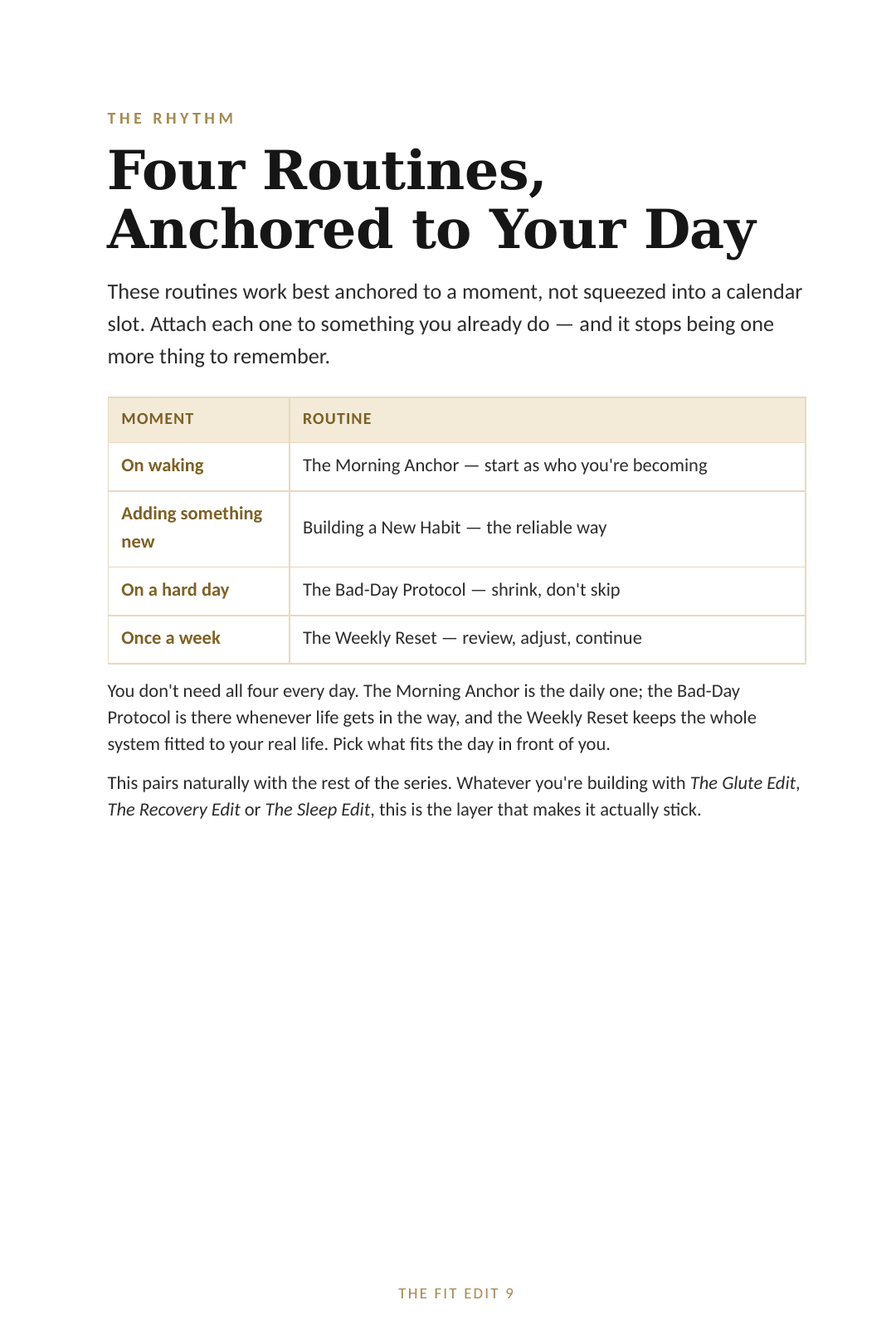
The Rhythm
Morning Anchor, Building a New Habit, Bad-Day Protocol and Weekly Reset — fitted around moments already in your day.
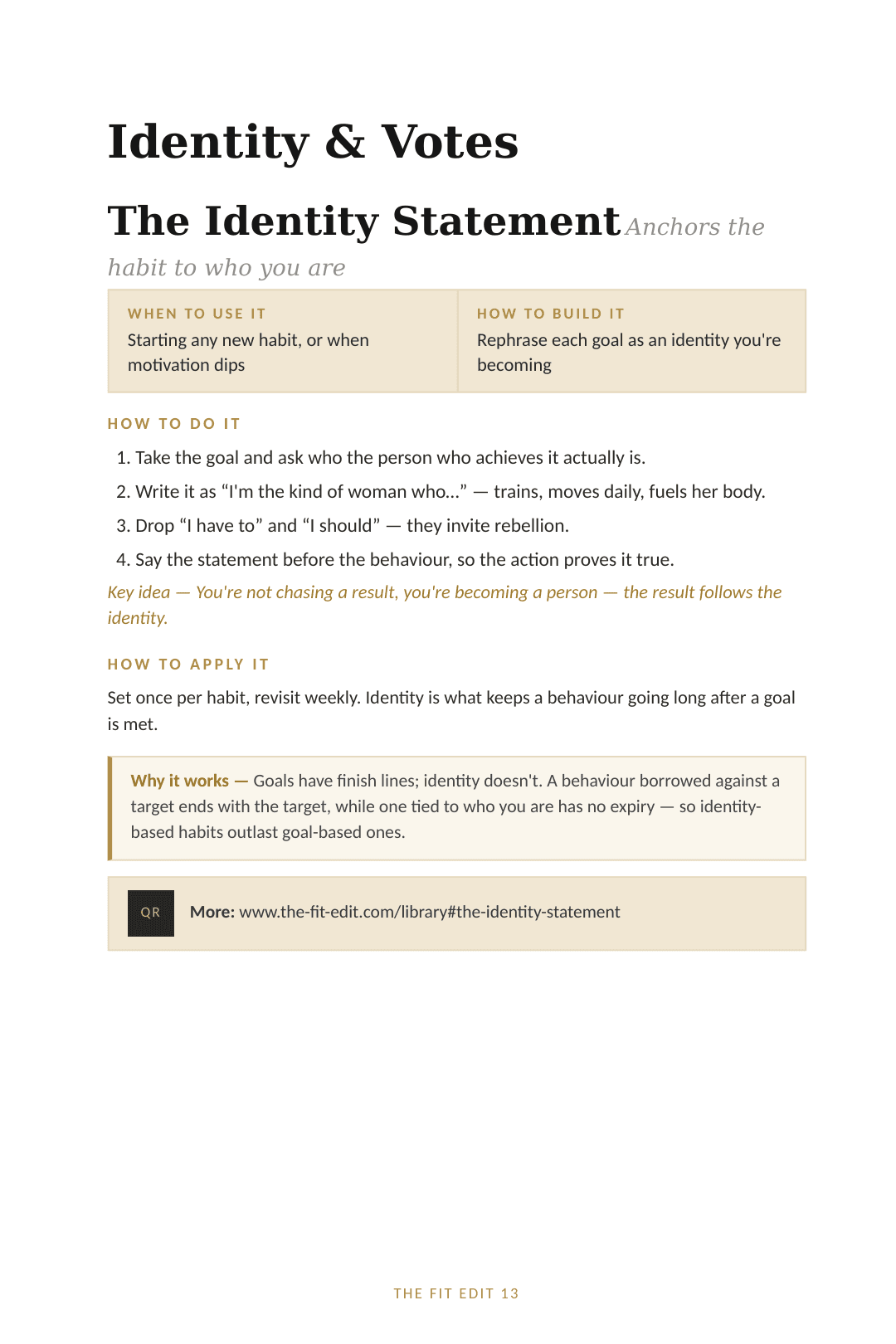
The Toolbox
Turn a goal into an identity and use each repetition as evidence for the person you're becoming.
The 4-Week Build
A practical daily combination of identity, cue, ease and reward that keeps the habit visible and repeatable.
One complete system
20 tools. 4 routines. 4 weeks.
Use the reference library when you need a specific solution, then let the four-week program turn those tools into a system that fits your real life.
The Habit Edit
You need a system that survives a bad day.
Twenty practical tools, four anchored routines and a guided four-week build designed to help consistency become something you can rely on.
20
Tools
4
Routines
4
Weeks
1
Habit At A Time
Miss. Shrug. Return.
Small Votes · Cast Often · Never Twice